Celebrating Genocide – The Real Story of Thanksgiving

Contributing writer for Wake Up World
Thanksgiving: Celebrating all that we have, and the genocide it took to get it.
Thanksgiving is one of the most paradoxical times of the year. We gather together with friends and family in celebration of all that we are thankful for and express our gratitude, at the same time we are encouraged to eat in excess. But the irony really starts the next day on Black Friday. On Thursday we appreciate all the simple things in life, such as having a meal, a roof over our head, and the connection with those close to us. But in less than 24 hours, we literally trample over others in a mad dash to accumulate as many material possessions as possible at bargain-prices.
So what is the true history of Thanksgiving? Well, just like we have stories of Easter in which a magical bunny hops around the world and hides baskets of goodies for us to find, or stories of Christmas where Santa Claus travels the globe in one night to leave presents under the tree for good boys and girls – Thanksgiving, too, has its traditional myth which we share with our children. We recount stories of the Indians and Pilgrims getting together for a magical feast of brotherly love and appreciation. The only problem is that, unlike the other holidays, we never reveal the truth about Thanksgiving to our children as they grow older. In fact, most of us don’t understand its bloody history ourselves…
The first actual proclaimed “Day of Thanksgiving” came in 1637 in a meeting between the Pequot Indians and English religious mercenaries. The Pequot were celebrating their annual Green Harvest Festival, which resembles modern-day Thanksgiving. On the eve of the festival, the English demanded that everyone comes out of their homes, puts their weapons on the ground, and surrenders by converting to Christianity.
Those who obliged with these terroristic demands were either shot dead or clubbed to death. Those who stayed inside their longhouses – including women and children – were burnt to death. In all, more than 700 Pequot men, women, and children were slaughtered that day.
The “victory” was celebrated by the Governor of Massachusetts Bay Colony holding a feast and trumpeted this as a “Day of Thanksgiving.” During the celebration, they cut off heads of Natives and put them on display publicly; including beheading the Wampanoag Chief and impaling his head on a pole in Plymouth which stayed on display for the next 24 years.

The myth that still dominates the holiday.
New Family Values
I was in third grade and playing in my back yard, when I noticed a moving truck in the parking lot beyond the fence. We lived in a middle-class suburban community, but right beyond our fenced in yard, there was a Section 8 Housing Community.
As I stood and watched, a young boy around my age came running over to the fence to greet me.
“Hi, My Name is Doug,” he said, “We are moving in next door.”
It’s funny as kids, we are so free and we see someone our age and we just want to be friends. Someone we can spend time with. This shows the natural desire of human connection.
Doug and I became pretty good friends instantly. We spent time at each other’s house often, mostly playing Nintendo or throwing the ball around in the yard.
Until one day, one of my favorite video games was missing. No idea what happened, but the game was gone. We always had anywhere from three to 10 people over at our house and there is no way of knowing what happened to the game or if it was simply misplaced.
“No more going over to that Indian’s house,” my Dad told me, “He took your game.”
Indian? What’s an Indian? I remember thinking that to myself. To me, Doug was just my friend. Now, just like that, he was my Indian-friend. I knew very little about other races at that time. Sure, we saw that people looked different, but never attached a label like that.
The only thing I knew about Indians, I learned in school. And the things I learned in school, was just being passed down from what our teacher’s learned in school with no adjustments to the curriculum. We learned how to sit “Indian-Style,” we learned how to sing “Ten Little Indians,” learned what it meant to be called an “Indian-Giver,” and we learned to play “Cowboys and Indians.”
I can honestly remember in First or Second grade around Thanksgiving, we made headdresses and colored feathers to dress up like Indians. Then they told us how to do war-cries by putting your hand over your mouth and yelling, “Ahh-Ahh-Ooh-Ooh.”
They instructed the class that the Pilgrims came over from Europe to escape religious persecution. Upon arriving in America, they realized that there were already people living here. The brave Europeans encountered the Indians, who wore headdresses, make weird noises, and were uncivilized. So, the
Pilgrims decided to help them out and they had a giant feast together. Everyone got along and then for every year since then, we celebrate Thanksgiving.
But, Doug didn’t do any of those things. I never met an Indian, he was just a normal kid. But, I was told not to trust him. The irony of a white person not trusting an Indian is too much to even comprehend.
“Doug, do you have my video game?” I asked him, “And, I am not allowed to come over here anymore and you can’t come over to my house.”
“No, I don’t have it. Why would I take it? You always let me use it whenever I want,” he replied, “But I understand. I won’t come over anymore.”
As the next couple years went by, I start seeing more movies with Cowboys and Indians with the natives viewed as hostile savages and the cowboys save the country. I am now in fifth grade and have been trained and brainwashed to hate a race of people and believe that I am good and they are wrong. And, still no one has given me an answer as to what happened to all the Indians that lived here?
Then, I gained perspective from the oddest of sources – the comedy movie, “Addams Family Values.” In the movie, the children were at some type of summer camp in which they are putting on a play for their parents, reenacting the first Thanksgiving. All the rich-white privileged kids at the camp were playing the role of the wholesome pilgrims; whereas, the outcasts of the camp were stuck playing the part of the “uncivilized” Indians. As the pilgrims invited the Indians for a meal together, Wednesday Addams –playing the role of Pocahontas (although this is historically inaccurate as Pocahontas lived near the Jamestown Settlement) – decides to go off the script just prior to sitting down for the meal:
“Wait, we can not break bread with you. You have taken the land which is rightfully ours. Years from now my people will be forced to live in mobile homes on reservations. Your people will wear cardigans, and drink highballs. We will sell our bracelets by the road sides, and you will play golf. My people will have pain and degradation. Your people will have stick shifts. The gods of my tribe have spoken. They said do not trust the pilgrims. And especially do not trust Sarah Miller. For all these reasons I have decided to scalp you and burn your village to the ground.” [view scene]
I remember watching this scene and my friends were laughing hysterically, but not me. I was more in shock and awe. It all made sense. I realized that everything I had been told about history was a lie. And I have been searching for the truth ever since.
A National Day of Mourning
We are very impressionable as children and take what elders, parents, and teachers tell us as fact. It gets very difficult to break these thoughts that shape our identity. However, the story of Thanksgiving described above has only a small semblance of truth. The Pilgrims and Indians got together for a giant feast – one time. And in all recorded history of that time, there are actually only two documents of record reporting this event, over the total of three paragraphs – indicating the very minor significant of this event.
Thanksgiving Day is also known as The National Day of Mourning among Native American Tribes. In 1970, there was a huge celebration in Massachussets to celebrate the 350th anniversary of the landing of the Pilgrims. Today, there are still Wampanoags living in the area. On the day of the celebration, they asked one of them to speak:
“Today is a time of celebrating for you — a time of looking back to the first days of white people in America. But it is not a time of celebrating for me. It is with a heavy heart that I look back upon what happened to my People. When the Pilgrims arrived, we, the Wampanoags, welcomed them with open arms, little knowing that it was the beginning of the end. That before 50 years were to pass, the Wampanoag would no longer be a tribe. That we and other Indians living near the settlers would be killed by their guns or dead from diseases that we caught from them. Let us always remember, the Indian is and was just as human as the white people.
Although our way of life is almost gone, we, the Wampanoags, still walk the lands of Massachusetts. What has happened cannot be changed. But today we work toward a better America, a more Indian America where people and nature once again are important.”
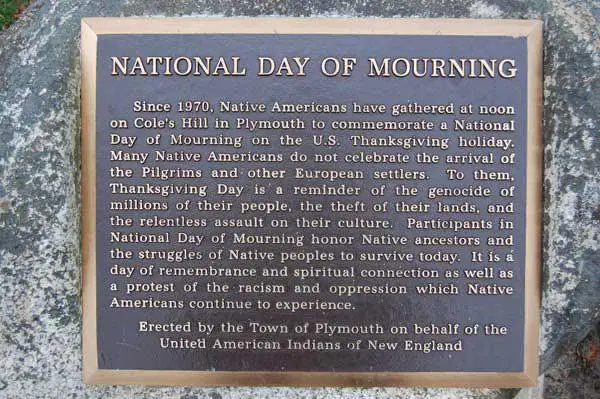
The National Day of Mourning plaque at Plymouth, Massachusetts
The Lies of Thanksgiving
To get started, the Pilgrims were not seeking religious persecution – they already had that in Holland by 1608. However, they did not like the work and demands of Holland and wanted to seek commercial ventures overseas. However the Pilgrims also had no money or resources, so they had to borrow a loan from the Virginia Company of London and Plymouth. The agreement stated that they were to take all the money earned over the first seven years and put it into a common stock – sounds like Communism.
So, the communist Pilgrims sailed across the sea in September of 1620. Yet, it is also important to note that they did not call themselves Pilgrims. They were originally referred to as Separatists as they no longer followed the Church of England. Yet, they referred to themselves as God’s Chosen People, in which they called themselves “Saints.”
The rest of England, considered them “religious dropouts.”
The Pilgrims were also not farmers, nor woodsmen; they were mostly city people and artisans that had no clue how to survive in the Wilderness. It would be like if a group of broke-hipsters decided to move to a remote jungle in South America to start their own civilization because they do not fit in with mainstream society. Yet, they don’t have money, so they take out a loan from the government to set up their little expedition.
They were not just being persecuted for religious beliefs either, they were revolutionaries who intended – and in fact, did in 1649 – overthrow the English Government.
On November 20, 1620, they landed at Cape Cod – not Plymouth Rock. A winter storm had sent them off-course and they were many miles north of their destination in Virginia. They landed in a desolated area in which the Patuxet used to live – but were completely wiped away by disease in 1617. The Pilgrims raided the land for corn, beans, and robbed the gravesites at Corn Hill to steal as much winter provisions as they could handle.
It wasn’t until another month later that they landed at Plymouth Rock. In which, the crew was decimated and the settlers were either dead or dying from starvation, malnutrition and disease. Only 53 of the remaining 102 members of this ship made it through the winter. In March, they were greeted by two English-Speaking Indians – Samoset and Squanto.
While this tale seems miraculous, in fact Plymouth Governor Bradford referred to Squanto as “a special instrument sent from God.” However, it was not that simple.
Squanto had been captured in 1605 and sold into slavery in England, in which he was forced to learn English. Then they sent him back to America, only to serve as a guide for the explorers to further ravage his land. In 1614, he was captured again and shipped to Spain. This time “rescued” by friars who tried to control the slaves and convert them to Christianity. He jump-shipped again and made his way back to his homeland in 1619, only to see that every member of his tribe had perished to disease. Hence, Squanto was the last living Patuxet and was forced to live with the nearby Wampanoag.
This is the man that helped the Pilgrims survive – enslaved twice, forced to learn English, attempted to be forced to convert to Christianity, then to return home and find everyone he loved was dead. If it were not for Squanto, all historians agree that the Pilgrims would have starved to death and had quite a different impact on American history.
As Governor Bradford explained:
“Squanto continued with them and was their interpreter and was a special instrument sent of God for their good beyond their expectation. He directed them how to set their corn, where to take fish, and to procure other commodities, and was also their pilot to bring them to unknown places for their profit, and never let them till he died.”
The Pilgrims were living in dirt-covered shelters, had no food, and nearly half of them had died during the winter. They obviously needed help and the two men were a welcome sight. Squanto, who probably knew more English than any other Indian in North America at that time, decided to stay with the Pilgrims for the next few months and teach them how to survive in this new place.
Squanto had orchestrated a treaty between the Pilgrims and Indians to protect each other from neighboring tribes.
By Fall of 1621, things had greatly improved for the Pilgrims. They put together a feast to celebrate their harvest – a common custom of the day in all parts of the world. This was celebrated back in Europe for many years, as well as the local tribes had six different “Thanksgiving” feasts throughout the year.
As they Pilgrims were shooting their guns in the air – likely with a mixture of the hefty amounts of alcohol they consumed – they were met by ninety or more Wampanoags. As the story goes, they invited the Indians to join them. However, it is more likely that the Indians rushed over to see what all the gunfire was about and then were asked to join. They had a three-day feast, in which the Indians provided the majority of the food.
This was never called “Thanksgiving” and it was not the beginning of some beautiful friendship, in which they all lived happily ever after. In fact, it never happened again. This was the first, and only, time that they got together in peace. The true “First Thanksgiving” was a much bloodier hell on Earth which tells the tale of the next 400 years for the Native Americans.

The “First Thanksgiving”
It is hard to tell the true intention of the first Pilgrims at Plymouth as they were severely outnumbered and had no means of survival in the New World. Once word was spread about the Paradise out West, more and more religious zealots, known as Puritans, came sweeping across the shores of America.
Once they arrived, they noticed no fences around the land and considered it all to be public domain. They were not in as great need of help from the Natives, as the original Pilgrims, and the friendship between the two weakened rapidly. Soon, the Pilgrims were demeaning the Indians for their religious beliefs and the children of those who shared this majestic meal together were killing each other in the next generation’s King Phillip’s War.
That is the foundation of America’s idea of “freedom.” We want freedom for ourselves, but not for those who do not look, think, act, and believe as we do. In the Declaration of Independence it is stated that “All Men Are Created Equal” but each of the founding fathers were slave-owners who valued white supremacy and favored Indian genocide. They didn’t want equality, they just wanted equality from the British, but the oppression they did to African-Americans, Indians, and Women was completely acceptable.
The Pilgrims were religious bigots who saw themselves as the “chosen elect” and first planned to purify themselves and then anyone who did not accept their interpretation of scripture. They believed they were fighting a holy war against Satan. In a “Thanksgiving” sermon in 1623, Maher the Elder gave special thanks for destroying “chiefly young men and children, the very seeds of increase, thus cleaning the forests to make way for a better growth.” Yes, thanking the Lord for giving smallpox to the same Wampanoag that saved them from starvation two years prior.
In 1637, as stated in the opening paragraphs of this article, the first Thanksgiving was held to celebrate the systematic slaughtering of the “heathen savages.” These killings become more and more, as the settlers went from village to village wiping out generations of tribes. With each “victory” they would hold days of thanksgiving feasts for each successful massacre.
During the next century, the Tribes continued to get pushed further West. The likes of Lord Jeffrey Amherst intentionally gave smallpox-infested blankets to tribes in the early forms of biological warfare. Whereas, the 1756 Indian Scalp Act paid out bounties for the scalps of Indian men, women, and children.
This continued up through the French-Indian War in which the British defeated the Indian-French allies; but proclaimed that the settlers can not go West of the Appalachian Mountains – not because they grew a heart for the Indians –but because it would be too hard to manage the settlers which would soon revolt against the Kingdom.
Even during the Revolutionary War, there were Days of Thanksgiving honored after a victory against the British. Until George Washington suggested that there is only one day of Thanksgiving set aside per year, rather than after each massacre.
The “Most Free Country on Earth”
After being declared a “free country,” the savagery continued. President Andrew Jackson issued the Indian Removal Act of 1830, which forced the Natives west to Oklahoma. The Cherokee removal from Tennessee became known as the infamous “Trail of Tears” in which Cherokee were slain in front of family members if they did not oblige.
As the land continued to be stolen, the Native Americans set up reservations. This land was not GIVEN to the Native Americans, it is land that THEY reserved for themselves that could not be taken from them. However, as we find out that did not seem to matter as the United States has broken every treaty ever signed with a Native American tribe.
It’s also important to understand that the government does not just hand out money “because they are Indians.” They are given money that is owed to them due to the treaties signed by the United States to purchase their land, and they settlements due to breaking every single treaty ever signed. It is not just a charity hand-out, it is part of a guilty plea.
However, false propaganda and poor educational curriculum like to inform the mainstream that we “gave the Indians reservations” and “pay them money.” This ignorance is a direct result of America not teaching their children what a treaty actually entails, or why it was signed in the first place.


In 1851, the Sioux made two treaties in which they were to be compensated with cash, food, and goods to give up over one-million acres of land to the United States, while living on the reservation. However, there were corrupt leaders in the Bureau of Indian Affairs who refused payments and gave goods out to white settlers instead. Once Minnesota became a state, Chief Little Crow took his grievances to Washington – in return, the United States took half of the land back from the Sioux and opened it up for white expansion.
Each year the situation got worse, until the summer of 1862 in which the Sioux were literally starving in these unlivable situations. This is referred to in history as the “Sioux Uprising.” They were “uprising” because you were starving them to death because of lies and broken promises.
One day a group went off the reservation hunting and stole some eggs from white settlers and eventually murdered them. The authorities in Minnesota then rounded up 303 Sioux, many of which were not involved in the uprising, and sentenced them to be hung to death. The Great Emancipator, President Abraham Lincoln issued the largest mass-killing in American history with the hanging of 38 Santee Sioux in Mankato, Minnesota. He reduced the number to 38 in fear that European nations may take the side of the South in the Civil War and exchange he promised Minnesota to kill or remove any Indians from Minnesota and pay $2 million in settlement – he only owed the Sioux$1.4 million for the land.
One year later, Congress expunged all Sioux treaties from the records, took back their reserved land and ordered the entire tribe to be expelled from Minnesota. As an incentive, a bounty of $25 was offered for the scalp of any Sioux found living in the state. In the same year, President Lincoln decided that Thanksgiving should be a Federal Holiday.
During this time, the Wild-Wild West included the likes of Custer going from camp-to-camp killing Indian women, men, and children for sport. They would burn, rape, and mutilate entire villages and were celebrated in the news as heroes. This includes his raid of the sleeping Cheyenne and their peace Chief Black Kettle, despite his previous surrender to the military and willingness to live on the reservations.
In 1890, on the Pine Ridge Reservation the Natives were practicing ghost dances, in which the military was called in and turned a peaceful dance into a massacre with another 300 dead at the hands of their conquerors.
“The people who are citizens of the U.S., these are your treaties. They aren’t just the Indians’ treaties. No one gave us anything. No one was dragging any land behind them when they came here. This was our land… As native American peoples in this red corner of Mother Earth, we have no reason to celebrate an invasion that caused the demise of so many of our people, and is still causing destruction today.” ~ Suzan Shown Harjo, the Morning Star Institute, a national Native American rights organization.
Boarding Schools
As the Sioux Wars ended, and it wasn’t as easy to deliberately kill the Indians, the Americans needed a new way to carry out genocide. They introduced the Boarding School System in 1890. This was United States Government policy that they could show up at your doorstep, take away your infants and toddlers and ship them to boarding schools hundreds of miles away. Your children were no longer yours.
At these schools they were banned to speak native languages, mocked their traditions and cultures, cut their hair, made them look American, as well as physically, emotionally, and sexually abused on a daily basis. Some children would never see their parents again. Or if they did, they had become different people.
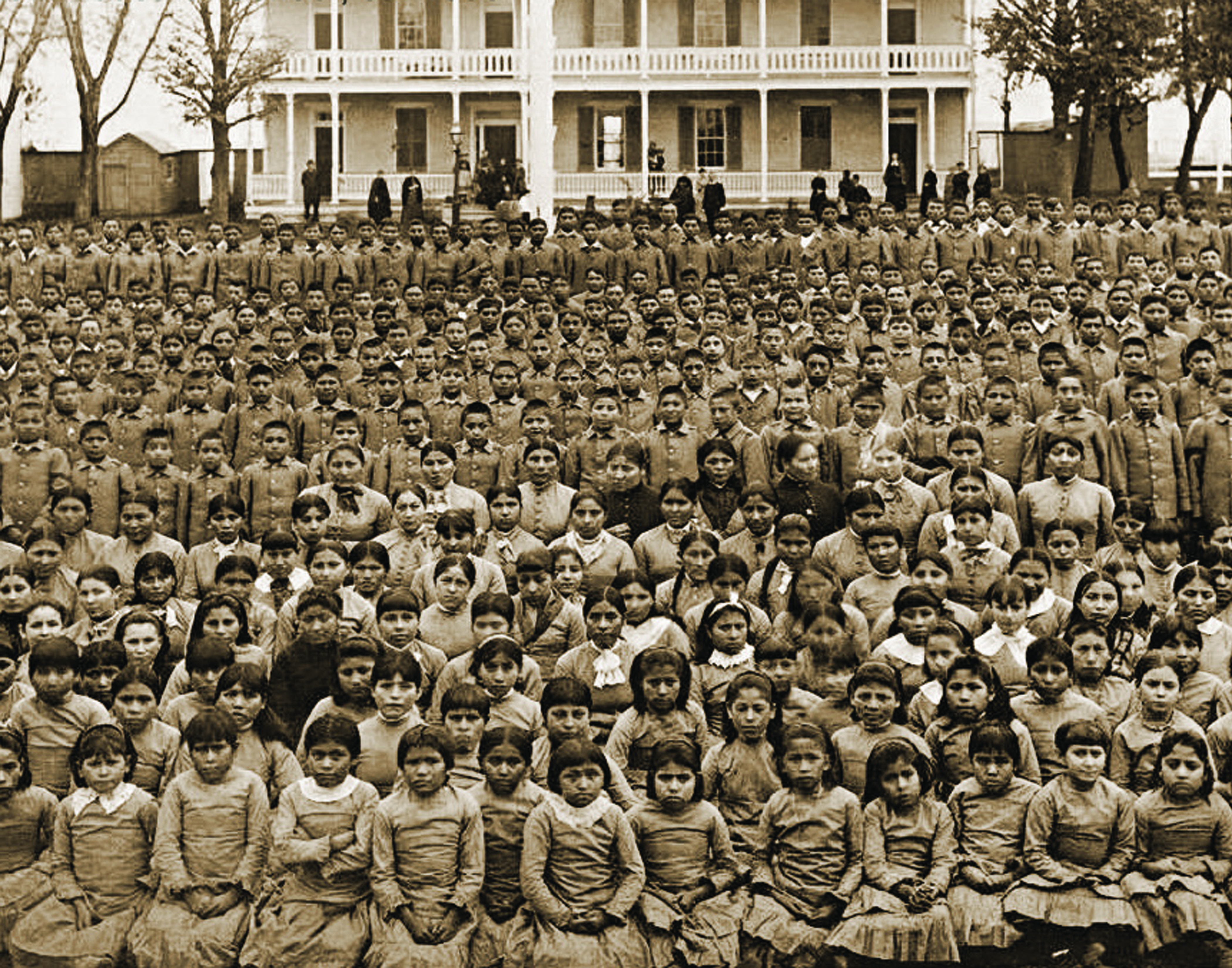
The government engaged in a cultural assimilation campaign, forcing thousands of Native American children into boarding schools.
It was a systematic eradicating of a race of people, they looked Indian but they were Americanizing them. Every Indian today is a product of this boarding school system. It peaked in the 1970s and carried into the 21st century.
In the 1950s, the United States then wanted to “re-civilize” the Indians and invited them to live back in the city. The problem is they had no money, education, or skills, and could not find work. Most of them ended up homeless or in jail.
Primitive Savages
There are volumes and volumes of dissertations written on this information listed above and it is difficult to condense it to less than a couple thousand words. (I encourage you to do you own research.) But in reading through the horrors, atrocities, genocide, and institutionalized racism enacted against the indigenous people, what is quite clear is that the label of ‘savages’ is on the wrong end.
Our society’s practice of “might is right”, consumerism, competition, separation and judgment is the opposite of how humans were designed to live. We were meant to live in harmony with each other and respect our fellow man. These ideas and values had already been in place for many years, but have been since removed by an advanced military society, but a primitive spiritual one.
“When your people came to our land, it was not with open arms, but with Bibles and guns and disease. You took our land. You killed us with your guns and disease, then had the arrogance to call us godless savages. If there is a Heaven and it is filled with Christians, than Hell is the place for me.”
Primitive spirituality and genocidal practices over the past four-hundred years have resulted in nearly 100 million deaths of indigenous people – making the Europeans the true primitive savages. Before the European invasion of the Americas, there were believed to be as many as 80-100 million native people occupying what is now the United States. According to the 2010 U.S. Census, only 5.2 million people in the U.S. identified as American Indian and Alaskan Native, either wholly or in part, and out of this total only 2.9 million people identified as solely American Indian or Alaska Native. At the time of European invasion, at least 300 different languages were spoken in addition to numerous “trade languages”. The natives of the Americas were not only “living lightly on the land”, as is so often claimed, but were engaged in landscaping, building and agriculture, trade and commerce, in addition to sustainable hunting and gathering, and of course, ancient cultural and earth-based spiritual practices — much of which has now been decimated.
When Christopher Columbus first landed in the Americas, ho entered an occupied land with force to subjugate and exterminate the civilizations that had existed for at least 30,000 years (some estimates are as high as 200,000 years), a trend that continued for several hundred years. And although he and the colonists that arrived in the years to follow have become icons of our national mythology, the result has been mass assimilation, raping, slaughtering, enslaving, and intention to wipe out all evidence of a native population of between 50 and 100 million indigenous people from the land — the greatest genocide in recorded history.
But, one day out of the year, we are able to give thanks and show gratitude as part of the traditional celebration to honor a bloody massacre.
Related reading:
Recommended reading by Irwin Ozborne:
- Over The Rainbow: The (Yellow Brick) Road to Enlightenment
- The Other Side: The Spiritual Gift of Borderline Personality Disorder
- The War On Drugs: How the “Land of the Free” Became the “Home of the Slaves” for 2.3 Million Americans
- Celebrating Genocide – Christopher Columbus’ Invasion of America
- Licensed to Kill: Psychiatry, Big Pharma and the State-Sanctioned Drug Cartel
- The Craving Behind the Craving: Addiction as a Spiritual Disease
- Bipolar? Or Gifted? The Modern Day Epidemic of Medicated “Madness”
- The Fictions Surrounding ADHD and the “Chemical Imbalance” Theory of Mental Illness
- What If We Are the “Bad Guys”?
- The Other Side: The Spiritual Gift of Borderline Personality Disorder
- Drug Addiction: A For-Profit Epidemic
About the author:
A writer and avid historian, Irwin Ozborne (a pen-name) is a survivor of childhood abuse and torture over a period of 13 years, a recovered alcoholic, and co-author of the book “Taking the Mask Off: Destroying the Stigmatic Barriers of Mental Health and Addiction Using a Spiritual Solution”. As a mental health practitioner, today Irwin practices holistic care and incorporates eastern philosophy into his work with clients. Irwin is also a contributing writer for Taking The Mask Off, a website dedicated to shining a light on the mental health industry, as well as other areas of our society that are shrouded in deceit and misinformation.
Irwin is available for speaking engagements as well, and can be contacted via email here.
You can follow Irwin’s work at:
Taking the Mask Off: Destroying the Stigmatic Barriers of Mental Health and Addiction Using a Spiritual Solution

“Taking the Mask Off” is the new book by Cortland Pfeffer and Irwin Ozborne. Cortland Pfeffer spent years as a patient in psychiatric hospitals, treatment centers, and jails before becoming a registered nurse and working in the same facilities. Based on his experience, this story is told from both sides of the desk. It offers a unique and valuable perspective into mental health and addiction, revealing the problems with the psychiatric industry while also providing the solution – one that brings together science, spirituality, philosophy, and personal experience.
“Taking the Mask Off: Destroying the Stigmatic Barriers of Mental Health and Addiction Using a Spiritual Solution” is available through Amazon and Balboa Press.


